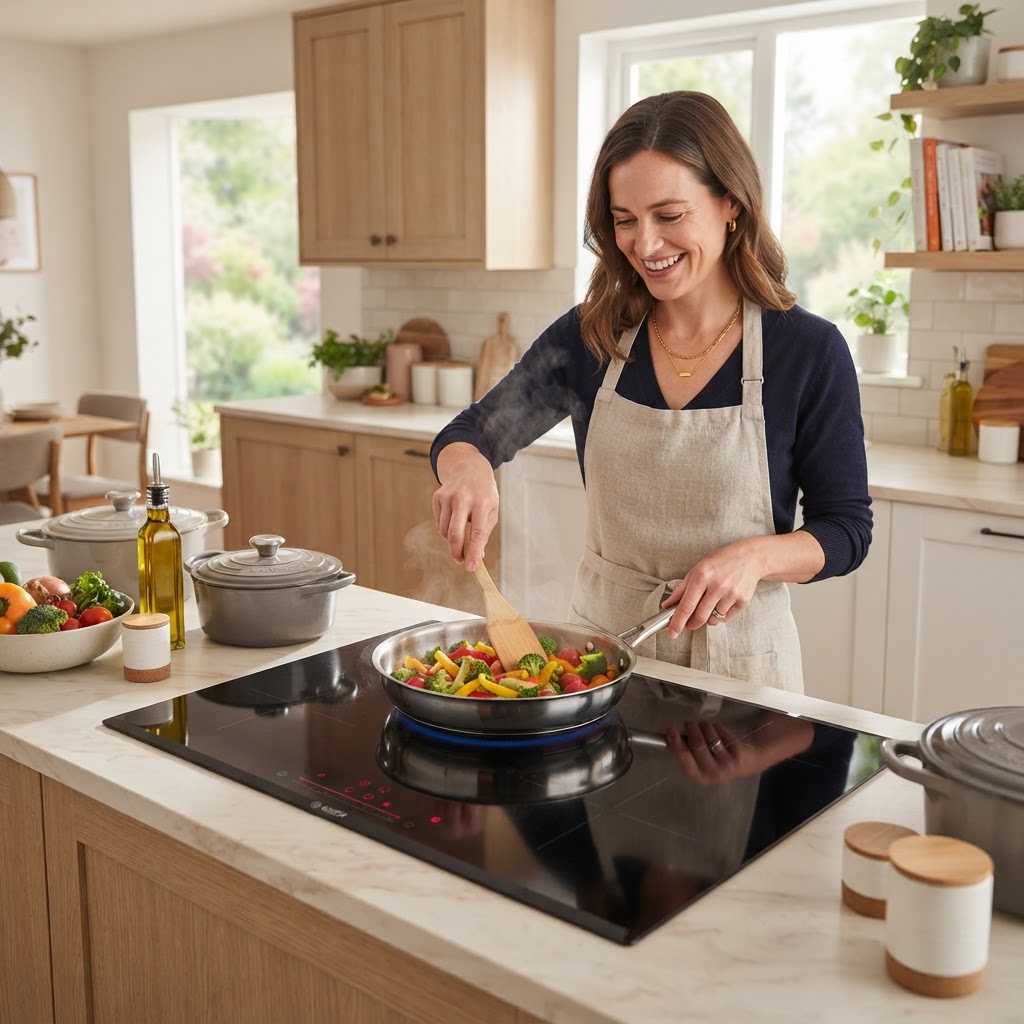
For decades, residential kitchen debates were cleanly split between the raw, visual control of a blue gas flame and the budget-friendly reliability of electric radiant coils. However, modern culinary technology has decisively shifted in favor of a superior alternative: induction cooking. Whether you are an avid home chef searching for pinpoint temperature precision or a homeowner focused on cleaner indoor air and long-term utility savings, the benefits of induction cooking are rapidly changing the heart of the home. Moving beyond mere novelty, induction appliances have become the gold standard in high-performance kitchen renovations.
How Induction Cooking Works: Electromagnetic Precision
To understand the unique induction cooking benefits, you first need to understand how the underlying physics differ from conventional heating. Traditional gas burners ignite fossil fuels to create thermal energy, while electric radiant stoves push current through resistance wires that get red-hot beneath a ceramic glass surface. In both legacy methods, heat transfers indirectly: burner to pan, pan to food, with an enormous amount of wasted heat escaping into your ambient kitchen air.
Induction fundamentally flips this equation. Beneath the sleek glass cooktop sits a tightly wound coil of copper wire. When an alternating electrical current passes through this coil, it generates an invisible, high-frequency electromagnetic field. This field produces no heat on its own. However, when ferromagnetic cookware (such as cast iron or multi-clad stainless steel) is placed within the zone, the field induces microscopic electrical currents—known as eddy currents—directly inside the base of the pan. Because the metal resists these currents, instantaneous, highly uniform heat is generated directly in the pan itself, bypassing the cooktop surface entirely.
Top Induction Cooking Benefits for Homeowners
When homeowners upgrade to induction, they experience tangible improvements in everyday lifestyle, efficiency, and safety. Here are the standout reasons why kitchen renovators and culinary professionals are choosing induction:
- Unmatched Speed and Boiling Performance: Because heat is generated directly inside the pan, energy transfer is practically instantaneous. A 6-quart pot of cold water typically reaches a rolling boil in under 3 minutes—nearly twice as fast as the most powerful gas residential burners.
- Sub-Degree Precision and Simmer Control: Gas flames fluctuate with room drafts, and standard electric coils cycle on and off abruptly. Induction elements allow seamless micro-adjustments. You can effortlessly melt delicate chocolate directly in a pan without a double boiler, maintain a whisper-low simmer for hours, or transition instantly to an intense high-heat sear.
- Supreme Energy Efficiency: According to evaluations highlighted by organizations like Energy Star, induction systems deliver roughly 85% to 90% of their operational energy directly into the food. By comparison, gas cooktops lose up to 60% of their generated heat into the surrounding air.
- Unrivaled Safety in the Kitchen: Without open flames, glowing elements, or gas leaks, the risk of accidental burns or kitchen fires drops dramatically. Because the glass only absorbs residual heat from the bottom of the pan, the surrounding surface stays cool enough to touch safely. Most units feature automatic shut-off triggers that kill power instantly when cookware is removed.
- Effortless, Streak-Free Cleanup: Because the smooth ceramic surface never reaches baking temperatures, food spills and boil-overs never bake onto the glass. You can quickly wipe the surface clean with a damp microfiber cloth immediately after removing the pan.
Health and Indoor Air Quality: Leaving Gas Byproducts Behind
In recent years, medical professionals, environmental regulators, and public health researchers have raised red flags regarding the indoor air quality impacts of open-flame cooking. When burning natural gas or propane indoors, ranges release combustion byproducts such as nitrogen dioxide (NO2), carbon monoxide (CO), fine particulate matter (PM2.5), and trace benzene into your living space. In poorly ventilated homes, running a gas stove can cause indoor air pollution levels to surge well past legal outdoor health thresholds.
Switching to induction eliminates indoor combustion entirely. For households with young children, elderly family members, or individuals living with respiratory conditions such as asthma, an induction upgrade provides clean, breathable peace of mind. As you plan broader home efficiency upgrades, check out our essential home maintenance guide for strategies on keeping your ventilation, ductwork, and appliances functioning at peak safety.
Cookware Requirements: The Simple Magnet Test
One of the most persistent misconceptions about induction is that you must discard your entire kitchen inventory and spend thousands on specialized cookware. In reality, most high-quality pots and pans already work seamlessly.
To work on an induction range, cookware must contain magnetic iron. Compatible materials include:
- Traditional cast iron and enameled cast iron (e.g., Le Creuset)
- Magnetic stainless steel and multi-clad tri-ply cookware
- Carbon steel woks and skillet pans
- Porcelain-coated or enameled steel
Uncoated aluminum, solid copper, and standard borosilicate glass pans will not activate the electromagnetic field. The easiest way to verify your current collection is the magnet test: grab a standard refrigerator magnet and touch it firmly to the base of your pan. If the magnet snaps into place and grips securely, your cookware will perform flawlessly on induction.
Installation Realities: Electrical Upgrades and Hiring a Professional
While using an induction appliance is straightforward, installing one requires careful technical planning. An induction cooktop or range is a high-power electrical appliance that demands a dedicated 240-volt circuit, usually rated for 40 to 50 amps depending on burner size and total kilowatt draw.
If you are replacing an existing 240V electric smoothtop range, installation is often a plug-and-play process. However, if you are transitioning away from a natural gas stove, the process involves two critical specialized trades:
- Gas Plumbing: A certified plumber must safely disconnect, cap off, and pressure-test the existing gas supply line to prevent hazardous leaks.
- Electrical Upgrades: A licensed electrician must verify your main service panel capacity (ensuring you have at least a 100A or 200A main service breaker), pull a new dedicated 240V line to the kitchen cavity, and mount the appropriate receptacle or junction box.
Handling high-voltage circuits and fuel pipes carries serious safety liabilities. To ensure complete compliance with local building codes, avoid DIY shortcuts and consult verified experts. You can read our detailed guide on how to hire a service professional to help vet licensed contractors, compare quotes, and confirm general liability credentials. When you are ready to move forward, platforms like FIND-A-PRO make it easy to source and hire top-rated, certified electricians and technicians in your immediate area.
Frequently Asked Questions About Induction Cooking
Q: Can I use an induction cooktop if I have an implanted pacemaker?
A: Because induction appliances emit low-frequency electromagnetic fields within their close perimeter, individuals with medical implants such as pacemakers or insulin pumps should exercise reasonable caution. While most models pose no threat at typical operating distances, medical device manufacturers suggest maintaining at least 12 to 24 inches of distance while the cooktop is powered on. Consult your cardiologist and device manual before purchasing.
Q: Does an induction cooktop buzz or make noise while cooking?
A: You may occasionally hear a faint hum, click, or gentle buzz. This sound is generally caused by the internal cooling fan that keeps the internal induction coils cool, or by loose handles and lightweight clad metal layers vibrating at magnetic frequencies. Sturdy, heavy cookware such as cast iron minimizes or completely eliminates this vibration.
Q: Are induction ranges more expensive to repair than standard electric stoves?
A: Induction cooktops rely on sophisticated electronic power boards and microprocessor sensors, which can be more expensive to replace than standard infinite heat switches on conventional radiant ranges. However, because induction glass stays dramatically cooler, internal components and surface seals suffer far less cumulative thermal degradation over their operational lifetime, leading to excellent overall mechanical reliability when professionally installed.
Key Takeaways
Induction cooking represents the ultimate convergence of restaurant-grade culinary speed, ultra-efficient energy performance, and modern indoor health. While transitioning from natural gas requires initial planning and the expertise of qualified tradespeople, the long-term payoff is a cleaner, safer, and noticeably more responsive cooking experience. When you are ready to convert your kitchen electrical service or cap your gas line, turn to FIND-A-PRO to instantly connect with vetted, licensed local professionals who will get your upgrade done right the first time.