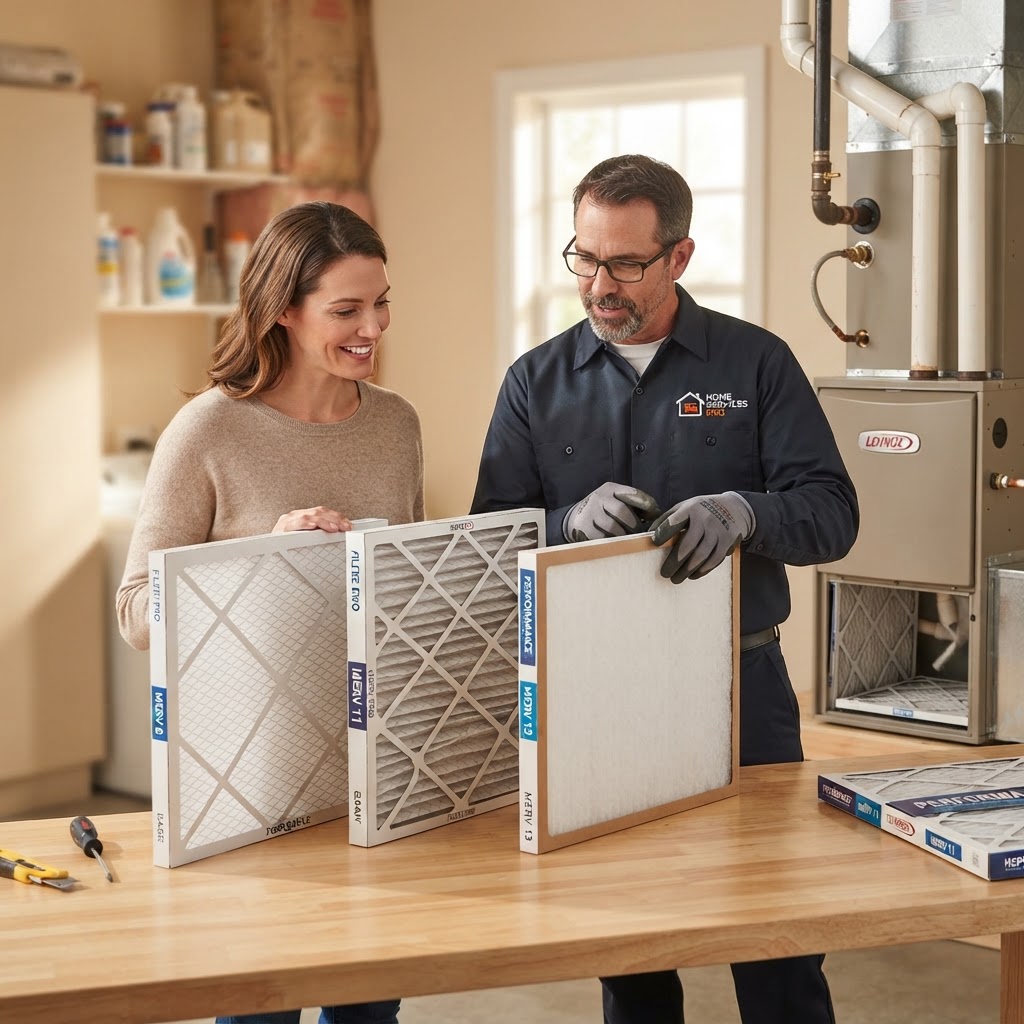
Standing in front of the home improvement store aisle or scrolling through endless online listings, you are confronted by a wall of air filters that look almost identical. Some cost four dollars; others run upwards of thirty. Some promise dust defense, while others boast hospital-grade purification. It is tempting to grab the cheapest option or, conversely, assume that the highest number or highest price tag is automatically best for your home. However, selecting an HVAC filter is actually a delicate balancing act between breathing cleaner indoor air and safeguarding the mechanical health of your heating and cooling equipment. In this comprehensive HVAC filter comparison guide, we break down filter materials, clarify the industry rating systems, explore airflow dynamics, and help you pick the exact filter your system needs.
Understanding the Primary Job of Your HVAC Filter
One of the most persistent misconceptions among homeowners is that an HVAC filter exists primarily to scrub household air clean for your lungs. While modern filtration certainly enhances indoor air quality, the filter's primary engineering purpose is to protect the HVAC equipment itself.
Every time your blower motor engages, it pulls return air from your living spaces back through ductwork and across critical heating and cooling components, such as your evaporator coils, heat exchanger, and blower fan. Without adequate filtration, household lint, hair, and dust would quickly coat these components. A dirt-laden evaporator coil cannot effectively transfer heat, leading to frozen coils, short-cycling, sky-high electric bills, and premature compressor or blower motor burnouts. To better understand how filter care fits into wider home health, check out our essential home maintenance guide.
Understanding this primary function is essential because choosing an air filter that is overly dense can strangle your system's airflow just as severely as running a completely filthy filter.
Comparing HVAC Filter Types: Pros, Cons, and Lifespans
Residential filters come in several distinct constructions, each presenting specific trade-offs between initial cost, filtration performance, and system airflow resistance.
- Fiberglass / Spun-Glass Filters (Disposable): These are the translucent, flimsy blue or white panels in cardboard frames. They capture only the largest debris, such as hair, carpet fuzz, and big dust clumps. While they introduce almost zero airflow resistance and cost very little ($1 to $5), they do virtually nothing to clean your breathing air or stop pollen and fine dust. They must be replaced every 30 days.
- Pleated Cotton or Polyester Filters (Standard Disposable): Pleated filters fold the filter media into an accordion shape, exponentially increasing the total surface area through which air passes. This design captures significantly smaller particles without producing catastrophic airflow restriction. Pleated filters are the residential standard, offering balanced performance for $8 to $20 and lasting between 60 to 90 days.
- Electrostatic Filters (Washable or Disposable): These filters employ self-charging synthetic fibers that act like a magnet for airborne dust, pet dander, and smoke particles. While reusable washable versions eliminate ongoing purchase costs, they possess notable downsides: their efficiency tends to be modest, and if you reinstall them even slightly damp after washing, they can foster mold and mildew colonies inside your furnace plenum.
- Deep-Pleat Media Filters (4-Inch to 5-Inch Thickness): If your HVAC system is fitted with a dedicated whole-home media cabinet rather than a 1-inch return grille, you can utilize deep-pleated filters. Because they pack up to five times more surface area into their deep folds, they provide superior particulate capture with less static pressure drop than thin 1-inch filters, often lasting 6 to 12 months between replacements.
- HEPA (High-Efficiency Particulate Air) Filters: True HEPA filters trap 99.97% of particles down to 0.3 microns. While standard in freestanding room air purifiers and medical facilities, true HEPA filters can rarely be fitted directly into a standard residential HVAC return frame. Their extreme density creates severe airflow resistance that will choke standard residential blower motors unless an engineered bypass system is professionally installed.
The MERV Rating Scale Explained (Plus FPR and MPR)
When comparing filters, you will encounter multiple rating metrics, but the universally recognized industry benchmark is the MERV rating (Minimum Efficiency Reporting Value), developed by the American Society of Heating, Refrigerating and Air-Conditioning Engineers (ASHRAE). MERV scales from 1 to 16 for standard residential and commercial systems.
According to guidance from the U.S. Environmental Protection Agency (EPA), residential filters rated MERV 13 capture at least 50% of microscopic particles (0.3–1.0 microns) and over 90% of intermediate particles (3.0–10 microns), including fine dust, automotive emissions, and droplet nuclei from coughing and sneezing.
Retail stores often feature proprietary rating systems developed by specific retailers and manufacturers:
- MPR (Microparticle Performance Rating): Used by 3M Filtrete, measuring particles between 0.3 and 1.0 microns. An MPR of 1000 roughly corresponds to MERV 11, while MPR 1500 to 1900 corresponds to MERV 12–13.
- FPR (Filter Performance Rating): A 1-to-10 rating created for The Home Depot. An FPR rating of 4–5 equates to MERV 8; 6–7 equates to MERV 11; and 8–10 aligns with MERV 12–13.
Always inspect the frame fine print to identify the true MERV rating so you can make an apples-to-apples comparison.
Direct Comparison: MERV 8 vs. MERV 11 vs. MERV 13
For most single-family residences, the decision comes down to three primary tiers:
- MERV 8: The gold standard for basic protection. It captures pollen, dust mites, carpet fibers, and mold spores. It offers virtually negligible airflow resistance and is compatible with almost every residential HVAC system in existence. Best for: Budget-conscious households without respiratory concerns or indoor pets.
- MERV 11: The sweet spot for family comfort. MERV 11 captures everything a MERV 8 stops, plus pet dander, lint dust, and auto emissions. Best for: Homes with pets, children, or mild seasonal allergy sufferers. Most modern HVAC blowers handle MERV 11 with ease.
- MERV 13: Premium residential purification. In addition to standard allergens, MERV 13 captures bacteria, fine smoke particles from cooking or regional wildfires, and sneeze droplets. Best for: Households managing asthma, autoimmune conditions, or areas frequently exposed to wildfire smoke.
Warning: Never install a MERV 13 1-inch filter into an older or undersized HVAC system without confirming that your blower motor can manage the static pressure. A choked blower will overheat, freeze up your AC coils, and spike your energy bills.
Airflow Resistance and Static Pressure: The Hidden Danger
To conceptualize static pressure, imagine trying to sprint while breathing through a drinking straw versus a wide snorkel. When an air filter is too restrictive—or completely plugged with dirt—your HVAC system struggles to draw sufficient air volume. This resistance creates high static pressure in the ductwork.
The consequences of excessive static pressure include:
- Reduced Comfort: Rooms situated far from the air handler become drafty, warm in summer, or cold in winter due to low airflow delivery.
- Blower Motor Burnout: Permanent Split Capacitor (PSC) motors slow down and overheat under high load, while modern Electronically Commutated Motors (ECM) will ramp up to maximum speed to compensate, consuming excess electricity and prematurely wearing out internal circuitry.
- Cracked Heat Exchangers: In winter, insufficient airflow causes heat to build up inside the furnace plenum. Overheating repeatedly stresses the heat exchanger metal, causing structural cracks that can leak lethal carbon monoxide into your home.
If you are uncertain whether your system can accommodate higher MERV ratings, you can easily use FIND-A-PRO to connect with certified local HVAC technicians who can perform a quick static pressure test on your return plenum.
How to Measure and Choose the Exact Right Size
Air filter packaging displays two distinct dimensions: Nominal Size and Actual Size.
The nominal size is the rounded number printed in large bold print on the box (e.g., 16 x 25 x 1). The actual size, usually printed in smaller font nearby, represents the true physical measurements in fractions of an inch (e.g., 15.5 x 24.5 x 0.75). Installing a filter that is even a half-inch too small allows unfiltered air to blow around the edges—a damaging phenomenon known as filter bypass. If you force a filter that is too large, the frame will bend or crush, destroying the airtight seal.
Before ordering replacements, measure your existing filter's frame with a tape measure, or measure the inside dimensions of your filter track or return cabinet.
Replacement Frequency and Best Maintenance Practices
While manufacturer packages often state that filters last 'up to 90 days,' your real-world replacement cadence should reflect your specific lifestyle factors:
- Vacation / Second Home: Every 6 to 12 months.
- Average Suburban Home (No pets): Every 60 to 90 days.
- Home with 1 Dog or Cat: Every 45 to 60 days.
- Multiple Pets, Smokers, or Severe Allergies: Every 30 to 45 days.
- Home Renovation / Drywall Work: Check and swap weekly during construction.
Professional Tip: Always note the installation date on the edge of the cardboard frame with a marker when you insert it. Check the airflow arrow printed along the perimeter: the arrow must always point toward the blower motor / furnace unit and away from the return room ductwork. When performing complex seasonal servicing, read our guide on how to hire a service professional to ensure your system gets a comprehensive inspection.
Frequently Asked Questions About HVAC Filters
Q: Will a higher MERV rating eliminate home dust completely?
A: No filter eliminates household dust entirely. Much of domestic dust consists of skin flakes, carpet lint, and fabric fibers that settle directly onto furniture before ever being drawn into your return registers. While higher MERV filters capture a much greater percentage of airborne dust, regular vacuuming with a sealed HEPA cleaner remains essential.
Q: Can I run my HVAC system without an air filter for a few days?
A: Never run your heating or cooling system without a filter, even for a short period. Airborne hair and dust will directly impinge upon your wet air conditioning evaporator coil or furnace blower blades. The labor cost to chemically clean a plugged evaporator coil far exceeds the minor inconvenience of buying a replacement filter.
Q: Are washable electrostatic filters better than disposable pleated filters?
A: For most homes, disposable pleated filters are superior. While washable filters eliminate recurring retail costs, their cleaning requires thorough hose-down cycles and complete air-drying. Reinserting a wet filter creates an immediate microbial breeding ground inside your HVAC ducts, and washable filters rarely achieve filtration efficiencies higher than a basic MERV 6.
Key Takeaways
Selecting the right HVAC filter does not require an engineering degree, but it does require balancing your family's air quality needs with your system's operational limits. For most households, a well-made MERV 8 to MERV 11 pleated filter changed on a predictable schedule provides the ideal sweet spot of pristine coil protection, energy efficiency, and low static resistance. If you are noticing persistent airflow imbalances, strange whistling noises from your filter grilles, or want to explore whole-home media air cleaners, turn to FIND-A-PRO. Our platform instantly connects you with vetted, licensed local HVAC specialists who can evaluate your equipment and keep your home comfort systems running at peak performance year-round.
