If you are looking for one of the simplest, most effective ways to lower your monthly utility bills, look no further than your ceiling. Lighting accounts for a significant portion of the average household energy budget, yet many homeowners are still relying on outdated, inefficient technology. Transitioning to energy efficient lighting is not just about being 'green'—it is a smart financial move that pays for itself through reduced energy consumption and fewer trips to the store for replacement bulbs. In this guide, we will walk you through everything you need to know to brighten your home while keeping your wallet happy.
Why Traditional Lighting is Costing You Money
For over a century, incandescent bulbs were the standard. However, they were incredibly inefficient. According to the U.S. Department of Energy, traditional incandescent bulbs released 90% of their energy as heat rather than light. Essentially, you were paying to heat your home with your light fixtures, which is the opposite of what you want during the summer months.
While Compact Fluorescent Lights (CFLs) were the first major step toward efficiency, they have largely been surpassed by Light Emitting Diode (LED) technology. LEDs are solid-state devices that produce light much more efficiently, using up to 90% less energy than their incandescent predecessors and lasting up to 25 times longer.
Understanding the Benefits of LED Technology
Switching to LEDs is the single most impactful change you can make for your home's electrical efficiency. The benefits go far beyond just lower electricity bills:
- Longevity: An LED bulb can last 20 years or more, meaning you won't be climbing ladders to change bulbs nearly as often.
- Durability: Unlike fragile incandescent filaments or glass CFL tubes, LEDs are robust and resistant to vibrations.
- Cool Operation: LEDs emit very little heat, making them safer to touch and reducing the cooling load on your air conditioning system.
- Instant Brightness: Unlike some CFLs that take time to 'warm up,' LEDs provide full brightness the moment you flip the switch.
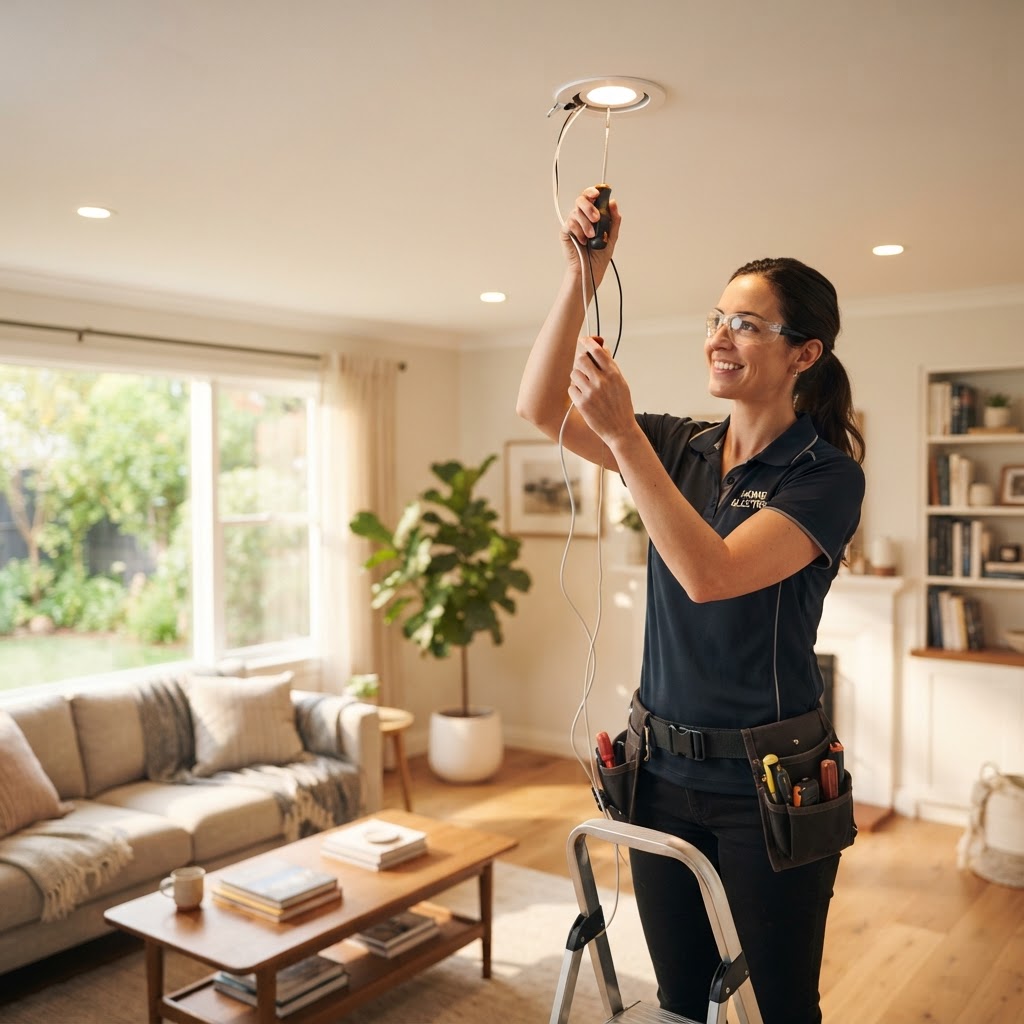
If you are planning a larger renovation, it is always a good idea to consult with a professional to ensure your wiring can support modern smart-lighting systems. You can learn how to hire a service professional through our guide to ensure your electrical upgrades are handled safely and correctly.
How to Choose the Right Bulbs: Lumens vs. Watts
One of the biggest mistakes homeowners make is shopping for bulbs based on 'watts.' In the old days, we used watts to measure brightness, but watts actually measure energy consumption. Because LEDs are so efficient, a 10-watt LED can be as bright as a 60-watt incandescent.
Instead, look for lumens. Lumens measure the actual light output. A good rule of thumb is that an 800-lumen bulb is roughly equivalent to a traditional 60-watt bulb. Additionally, pay attention to color temperature measured in Kelvins (K). A lower number (2,700K) provides a warm, yellowish light perfect for living rooms, while higher numbers (5,000K+) provide a crisp, daylight-like glow ideal for kitchens and workspaces.
Frequently Asked Questions About Energy Efficient Lighting
Q: Are all LED bulbs dimmable?
A: No. You must check the packaging to ensure the bulb is specifically labeled as 'dimmable.' Using a non-dimmable LED with a standard dimmer switch can cause flickering or damage the bulb.
Q: What does the ENERGY STAR label mean?
A: The ENERGY STAR label indicates that the product has been independently certified to meet strict efficiency and performance standards. Choosing these products ensures you get the promised energy savings and longevity.
Q: Can I use LEDs in enclosed fixtures?
A: Some LEDs are not rated for enclosed fixtures because the heat they do produce can get trapped and shorten the bulb's life. Always check the box to see if the bulb is rated for 'enclosed fixtures' if you plan to use it in a globe or recessed can.
Key Takeaways
Upgrading to energy efficient lighting is one of the highest-return investments you can make in your home. By replacing your most-used bulbs with ENERGY STAR certified LEDs, you can save hundreds of dollars annually while enjoying better, more reliable light. Whether you are swapping out a few bulbs or planning a complete home lighting overhaul, remember that proper installation is key to safety and performance. If you need help with complex lighting installations or electrical upgrades, FIND-A-PRO is your go-to resource for connecting with verified, local electrical professionals who can get the job done right the first time.
